
Implementation, system requirements, security, and how data gets into FINDER®. Detailed user guides and instructional videos are also in the Support section inside the platform.
Three calls on a weekly series, coordinated by your FINDER Sales contact:
The full walkthrough is in the onboarding guide.
When the MOU is signed, FINDER requests a data fragment of each applicable CAD, RMS and JMS system with a secure upload link. A fragment is a backup copy or structured export of the system so our engineers can build your parser; screenshots and printed reports do not work. Having it in by the kickoff is the biggest factor in how quickly your agency goes live.
Send fragments and user rosters only through the secure upload link FINDER provides. Do not send records or passwords in ordinary email. Our technical implementation lead can help your IT staff with what to pull.
At go-live, once your records are validated and your agency approves sharing. If your agency already uses FINDER Query, your people keep that access throughout implementation.
Active Directory export (preferred). You provide a current user list with names, agency emails and AD groups on the FINDER roster template. Your admin approves the group-to-role mapping, and each user receives an email invitation to accept and set a password. No passwords are exported.
Single sign-on. Recommended for agencies over 200 sworn. FINDER configures and tests it with your IT during activation, and users sign in through your agency identity provider.
Self-registration. Users register at login.findersoftware.com and your admin approves them.
Agency lead. The decision maker for the implementation.
IT contact. Prepares the Windows host, provides read-only access and the data fragments, and opens remote access for installation. Keep an ongoing IT contact for source-system upgrades and credential changes.
Records validator. Someone who knows your records. They compare several records side by side in FINDER and your source system, check the structured fields, and confirm record volumes look right.
FINDER Agency Administrator and a backup. Someone with knowledge of your personnel. They approve and deny account requests, edit and delete user accounts, expunge records, and run audits and logs, at the access level your agency assigns.
One person may hold more than one role.
No. FINDER installs an uploader on an existing agency Windows host that reads your records with read-only credentials and sends a copy to the platform. Your data fragment lets us configure the parser for your system, and validation confirms records return correctly.
Yes, through FINDER Integrate. Custom extract, transform, and load work moves legacy data from one database to another, which suits agencies changing RMS systems that want to keep their history.
We also build APIs so agencies can connect mapping tools, analytical programs, and external law enforcement data sources.
An existing approved Windows VM or physical machine that can reach your data sources and FINDER. A dedicated server purchase is not required.
The uploader is a .NET console application scheduled through Windows Task Scheduler. It uses roughly 100 MB of RAM, 2 GB of disk, and about 5 percent of CPU while running.
Outbound only. The host needs to reach your CAD, RMS and JMS sources and send records outbound to FINDER; if your agency restricts egress, allow outbound SFTP (port 22) from the host to FINDER. No inbound firewall change is needed. Users reach FINDER in the browser over HTTPS.
Your IT staff open an approved remote-access session at the end of the installation call and reserve a 3-hour window. They do not need to stay on the call. Where agency policy requires a monitored session, the agency provides the escort for the full window.
No. FINDER is a web application, so there is no client software to package, deploy, or patch. Users sign in at login.findersoftware.com from a current, updated computer with a high speed connection.
Supported browsers are listed on the general FAQ.
On AWS GovCloud, a secure cloud environment built to meet federal compliance requirements, which provides data protection, scalability, and resilience. More detail is on the Trust & Security page.
FINDER is designed to meet the technological directives established by the federal government for sharing law enforcement data. Our team members are CJIS trained.
Multi-factor authentication uses an authenticator app or hardware token, consistent with CJIS Security Policy v6.0 control IA-2. Email one-time passcodes do not satisfy that control and have been retired.
FINDER provides a secure upload link for data fragments, rosters, and other implementation files. Transfers also run through a Secure File Transfer Protocol server that is FIPS 140-2 compliant and secured end to end.
Bulletin Upload module. From the Dashboard, click the Bulletin Upload icon, choose your PDF files or drag several in at once, and submit. FINDER indexes people, vehicles, and property characteristics along with the bulletin date and classification, and they become searchable once processed. Requires the Bulletins module.
SFTP. We provide an SFTP folder for bulletins and other files. Contact support for access instructions.
Email. Create a forwarding rule in your department workflow to send bulletins automatically. Contact support for access instructions. To maintain CJIS compliance, the email option requires an email security certificate.
SFTP. The same SFTP folder handles hotlist files. Contact support for access instructions.
Email. Forward hotlist files to lpr@findersoftware.com through a department forwarding rule. This option should not be used for CJIS protected information.
The CLEAR connection is standard within FINDER Investigate. Users need active accounts with both FINDER and CLEAR, and your agency needs the CLEAR sharing API activated. Setup happens during implementation, or contact FINDER support or CLEAR support.
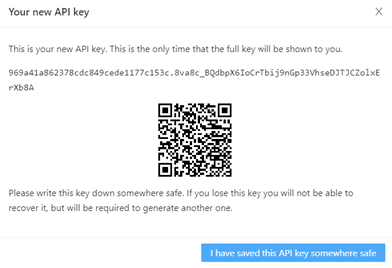
Our engineering team adds your unique Clearview API key to the system. To generate it: enable the API keys permission set in your Clearview admin section, click the drop-down beside your user name and select API Keys, then Create API Key, and name it for your agency. You will receive a QR code and an alphanumeric code. Send that code to your FINDER onboarding consultant.
Once your agency subscribes, and signs the data provider’s subscriber agreement if the provider requires one, FINDER support provisions the API key for search. Your agency administrator then enables permissions for the users who should have access.
Access is granted per user rather than agency wide by default. More detail is on the FINDER Public Records page.
Once your agency subscribes, and signs the data provider’s agreement if the provider requires one, FINDER support provisions the API key for search. Your agency administrator then enables permissions for the users who should have access.
Access is granted per user rather than agency wide by default. More detail is on the FINDER AdTech page.
The IRIS connection is standard in FINDER. Users need both a FINDER and an IRIS account, and IRIS must activate the account for data sharing to function. Setup happens during implementation, or contact FINDER support or IRIS support.
On the Product Release Notes page.
Submit it through the support form and our engineering team will review it. Not everything can be implemented, since development cycles are finite and the customer base is wide, but every request gets read.
Parsers need updating when your vendor ships a new version. Tell us ahead of the upgrade; we coordinate with your IT staff, update the parser afterward, and test to confirm every record type is still flowing. More detail is on the parsers page.
If your question is not covered here, open a support request and someone will pick it up.

Supporting law enforcement for over 20 years.
© 2026 FINDER® Software Solutions LLC